借助全新的优先级与分配功能,掌控你的广告系列支出
Guide your campaign spending with new priority and allocation features
以下为原文逐段中文翻译,保留图表与说明。AI 翻译并经 AI 对照复核,仍可能存在错误;核对数据和引用时请同时查看原文。译文发布:2026年10月17日 06:30(北京时间)。
2026年10月14日
|
告别全有或全无的渠道定位。你现在可以按优先级对广告网络进行分类,并为次要渠道分配预算,从而安全地对其进行测试。
你的浏览器不支持音频元素。
收听文章
[[duration]] 分钟
此内容由 Google AI 生成。生成式 AI 仍处于实验阶段。
营销人员希望对其广告系列有更高的透明度,并能自主选择如何调配广告预算。在“智能出价探索”(Smart Bidding Exploration)和“广告系列总预算”(campaign total budgets)等更新——这些更新将更多控制权交到广告主手中——的基础上,我们在 Google Ads 中推出全新的可选控制项:渠道优先级(channel prioritization)和预算分配(budget allocation)。随着这些控制项在全球范围内面向搜索、购物、效果最大化(Performance Max)和需求开发(Demand Gen)广告系列推出,营销人员在决定预算如何在 Google 库存和合作伙伴网络(如搜索合作伙伴和 Google 展示广告网络)之间流动时,将拥有更大的灵活性。
选择哪些渠道优先获得预算
渠道优先级让营销人员可以将特定渠道或渠道组合的库存归类为“高优先级”或“低优先级”,从而决定预算优先流向何处。配置完成后,广告系列将优先为高优先级渠道提供充足预算(在使用目标每次转化费用〔Target CPA〕或目标广告支出回报率〔Target ROAS〕时,在其目标范围内),然后将剩余预算分配给较低优先级的渠道。例如,在搜索广告系列中,营销人员现在可以根据自己的重视程度,将 Google 搜索、搜索合作伙伴和 Google 展示广告网络设为不同的优先级。在效果最大化和需求开发广告系列中,搜索、YouTube、地图、Gmail 和 Discover 等 Google 展示面被合并为“Google 渠道”并统一设定优先级。
这些控制项正陆续在账户和广告系列层级推出,同时也适用于共享预算。可以在搜索、购物、效果最大化和需求开发广告系列类型之间设置不同的优先级层级。
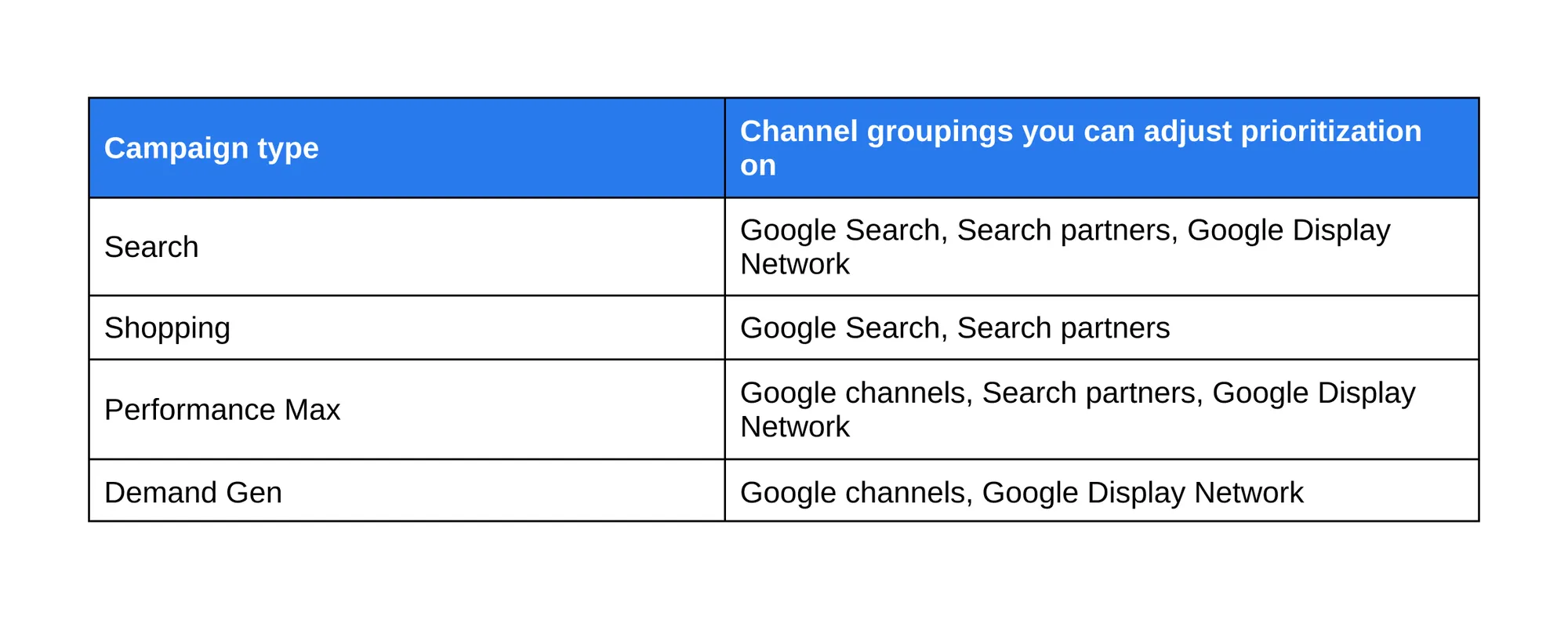
通过灵活的预算分配设置支出上限
通过这次更新,我们还在渠道层级引入了更灵活的预算分配控制项。当某个渠道或渠道组合被设为“低优先级”时,广告主可以指定每日预算的最高百分比,以将这些渠道的支出控制在期望的范围内。我们的工具将尽力使这些渠道的支出保持在上述限制之内。这对于采用目标每次转化费用或目标广告支出回报率出价、且不受预算限制的广告系列尤为有用,因为仅靠渠道优先级通常不会对这类广告系列产生影响。
这些功能让营销人员拥有比全有或全无的排除选项更多的控制权。过去一直排除搜索合作伙伴和 Google 展示广告网络的营销人员,可以利用这一新手段,在更有信心、限制更清晰的情况下测试这些网络,而不是将它们完全关闭。目前有广告系列在搜索合作伙伴或 Google 展示广告网络上投放的营销人员,可以选择设置预算分配。
从2027年2月起,对于已开启 Google 展示广告网络的搜索广告系列,当前的支出分配设置将取消,广告主可能会看到渠道支出的变化。若要保留当前配置,他们可以将 Google 展示广告网络设为“低优先级”,并设置50%的预算分配。
这些可选功能将在未来几个月内陆续面向搜索、购物、效果最大化和需求开发广告系列推出。有了这些新控制项,营销人员在假期临近时可以放心地投入支出,并在旺季满足需求。在我们的帮助中心了解更多。
发布于:
展开英文原文 · 与中文逐段对应
Guide your campaign spending with new priority and allocation features
Oct 14, 2026
|
Say goodbye to all-or-nothing channel targeting. You can now categorize ad networks by priority and allocate budget to secondary channels to test them safely.
Your browser does not support the audio element.
Listen to article
[[duration]] minutes
This content is generated by Google AI. Generative AI is experimental
Marketers want more transparency into their ad campaigns and choice over how they direct their ad budgets. Building on updates like Smart Bidding Exploration and campaign total budgets , which put more control into the hands of advertisers, we’re introducing new optional controls in Google Ads: channel prioritization and budget allocation . As these controls roll out globally across Search, Shopping, Performance Max, and Demand Gen, marketers will have even greater flexibility deciding where their budgets flow across Google inventory and partner networks, like Search partners and the Google Display Network.
Choose which channels get funded first
Channel prioritization lets marketers decide where their budgets go first by categorizing inventory as “High priority” or “Low priority” for specific channels or channel groupings. When configured, campaigns will fully fund high-priority channels (within their target when using Target CPA or Target ROAS) before allocating the remaining budget to lower-priority channels. For example, on Search campaigns, marketers can now set Google Search, Search partners, and Google Display Network into different priority levels depending on what they value. In Performance Max and Demand Gen campaigns, Google surfaces like Search, YouTube, Maps, Gmail, and Discover are prioritized together as "Google channels.”
These controls are rolling out at the account and campaign levels, and also apply to shared budgets . Distinct priority tiers can be set across Search, Shopping, Performance Max, and Demand Gen campaign types.
Set spending limits with flexible budget allocation
With this update, we’re also introducing more flexible budget allocation controls at the channel level. When a channel or channel grouping is set as "Low priority," advertisers will be able to specify a maximum percentage of their daily budget to stay within their desired boundaries on those channels. On a best-effort basis, our tools will aim to keep spend on those channels within that limit. This is particularly helpful for campaigns with Target CPA or Target ROAS bidding that are not limited by budget since channel prioritization alone will generally not have an impact there.
These features give marketers more control than all-or-nothing opt-outs. Marketers who have historically opted out of Search partners and the Google Display Network can use this new lever to test these networks with more confidence and clearer limits, rather than turning them off entirely. Marketers who have campaigns currently running on Search partners or the Google Display Network have the option to set a budget allocation should they choose.
Starting in February 2027, for Search campaigns with the Google Display Network turned on, the current spend allocation setup will go away, and advertisers may see a shift in channel spending. To keep their current configuration, they can set the Google Display Network to “Low priority” with a 50% budget allocation.
These optional features are rolling out to Search, Shopping, Performance Max, and Demand Gen over the next months. With these new controls in place, marketers can confidently spend as the holidays approach and meet demand during the peak season. Learn more in our Help Center .
Posted in:
查看本期独立摘要
中文独立摘要 · AI 整理
这件事
据谷歌官方博客报道,Google Ads推出新控件,让营销人员可按优先级对渠道分组分类,并更好地控制预算分配方式。报道称,营销人员希望广告投放更透明、对预算去向有更多选择;在此基础上,谷歌引入两项可选新控件:渠道优先级与预算分配。随着这些控件在搜索、购物、效果最大化(Performance Max)和需求开发(Demand Gen)中全球推广,营销人员将能更灵活地决定预算在谷歌自有资源与合作伙伴网络间的流向。
本页概括所列来源的重点,属于独立摘要;完整报道请阅读原站。整理时间:2026年10月17日 04:44(北京时间)。
信息从哪里来
依据 Google The Keyword 的RSS 摘要与原文节选整理,事实核对限于列明材料;不是原文全文翻译。
- Google The Keyword 来源报道(RSS 摘要与原文节选)