NASA 与合作伙伴加速推进 2028 年登月任务着陆器研发
NASA, Partners Accelerate Lander Development for 2028 Moon Missions - NASA
NASA 新闻发布
以下为原文逐段中文翻译,保留图表与说明。AI 翻译并经 AI 对照复核,仍可能存在错误;核对数据和引用时请同时查看原文。译文发布:2026年10月24日 07:25(北京时间)。
NASA 正将人类送回月球表面,并在我们最近的宇宙邻居上建立长期存在。为此,NASA 与商业载人着陆系统供应商 Blue Origin 和 SpaceX 已简化设计,并改变了两家公司未来载人着陆器的运行概念。
自 NASA 与 Blue Origin 和 SpaceX 签订载人登月任务的初始合同以来,该机构已将 Artemis III 重新定义为:明年在近地轨道演示各供应商着陆器测试版与 NASA 的 Orion 航天器之间的交会与对接能力。与此同时,两家公司也在为其近期的 Artemis 任务开发载人版和货运版着陆器。
“我们正在执行特朗普总统的《国家太空政策》,以完成美国人期待已久的、于 2028 年重返月球表面的目标,并建立月球基地,”NASA 局长 Jared Isaacman 表示。“我们在 SLS 和 Orion 上已有成熟可靠的基础,同时正与 Blue Origin 和 SpaceX 合作研发两款月球着陆器。但 NASA 绝无意在万事俱备时袖手旁观。阿波罗计划不是这样成功的,近乎不可能之事也不是这样实现的。NASA 已全员动员,我们的核心能力正在重建,我们的机加工车间 24 小时不间断运转,我们的专家正奋战在一线,攻坚关键路径。我们正在组建一支超级碗级别的团队,以安全实现这些目标以及随之而来的一切。”
NASA 全员动员:重建核心能力,攻坚关键路径

贾里德·艾萨克曼
NASA 局长
在最初的载人登月任务中,Artemis 宇航员将搭乘 NASA 的 Orion 航天器,由 SLS(太空发射系统)火箭从 NASA 位于佛罗里达州的肯尼迪航天中心发射升空。在每次 Artemis 任务中,商业载人着陆系统将先与 Orion 对接,随后搭载两名机组成员前往月球表面,另外两人则留在 Orion 上。为加速实现 2028 年着陆,Artemis 着陆器与 Orion 将不再于月球附近的近直线晕轨道交会,而是根据各供应商的系统,在与之不同的轨道上会合。
两家公司都被要求在近期的 Artemis 载人登月任务之前,用其载人着陆器执行一次无人演示任务。NASA 将在载人任务前对着陆器系统进行认证,以确保安全和任务成功。
Starship 着陆器运行概念
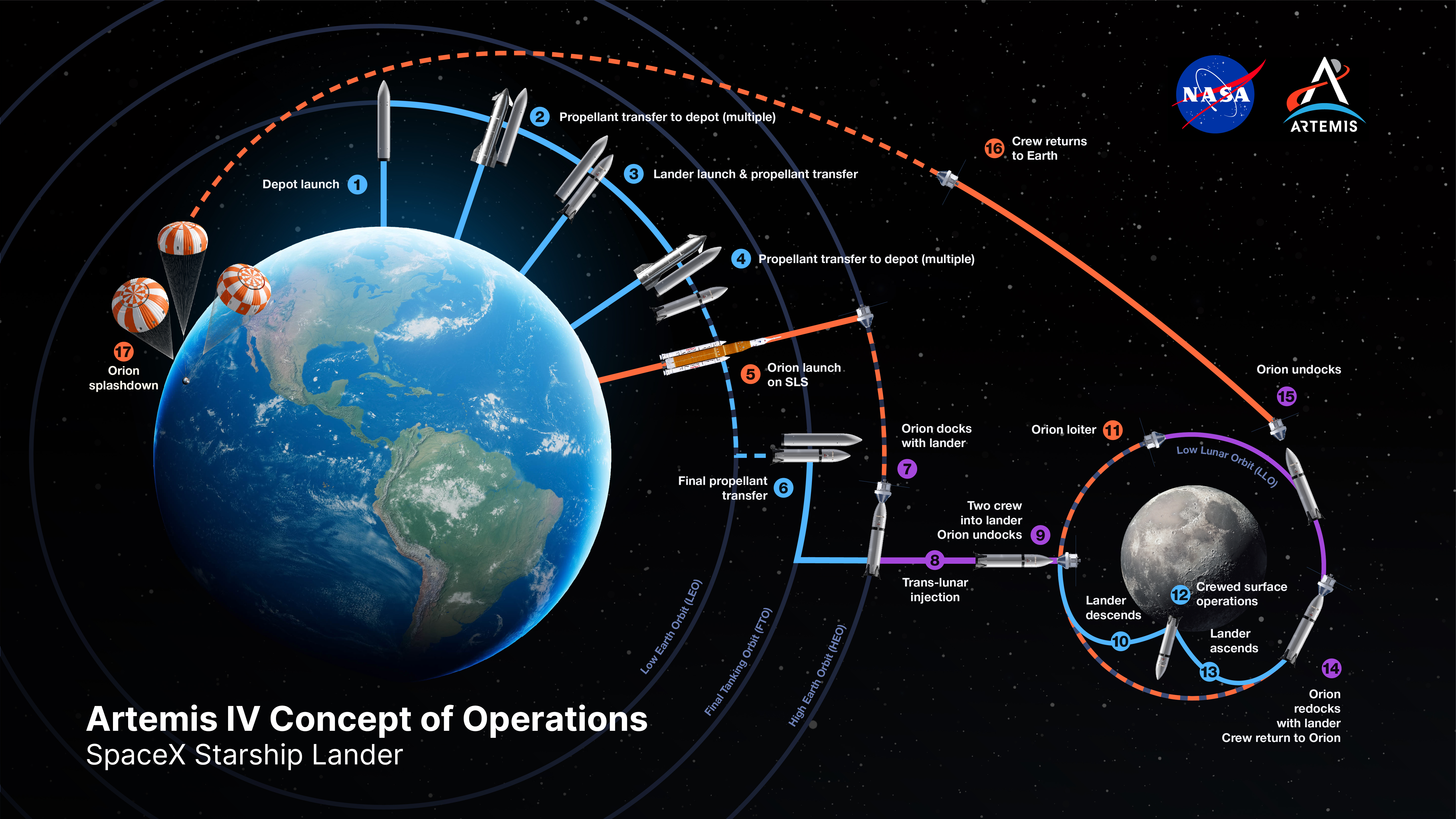
SpaceX 持续推进其“在轨推进剂集聚”方案,即在太空中转移极冷(低温)液体推进剂。在佛罗里达发射 Starship 载人着陆系统(HLS)之前,该公司将把多个版本的 Starship 送入近地轨道。类似于地球上的加油站,近地轨道上的一系列推进剂“tanker(加油船)”Starship 将把推进剂转移给等待中的“depot(补给站)”Starship。最终,补给站 Starship 将为前往月球的 Starship 着陆器加注燃料。
根据修订后的运行方案,Starship HLS 将在地球轨道上等待 Orion 及其机组。着陆器与 Orion 将在地球轨道上交会对接,随后 Starship 着陆器将执行地月转移轨道点火,将着陆器与 Orion 的组合体送往月球低轨道。NASA 正在对 Orion 进行改造,以使 Starship 能够将其推向月球。着陆器将搭载两名机组成员在月球表面停留数日,之后将他们送回 Orion,搭乘其返回地球。
在近地轨道进行推进剂集聚,使 SLS 的机组发射时机更具灵活性;而由 Starship 着陆器执行的地月转移轨道点火,则能直接抵达月球低轨道。这一使用月球低轨道的新运行概念,将大幅减少 Starship 需要在太空中集聚的推进剂数量,同时也缩短宇航员乘坐 Starship 离开月球表面后与 Orion 重新对接所需的时间。SpaceX 将在无人演示任务中演示这一推进剂集聚方案。
Blue Moon 着陆器运行概念
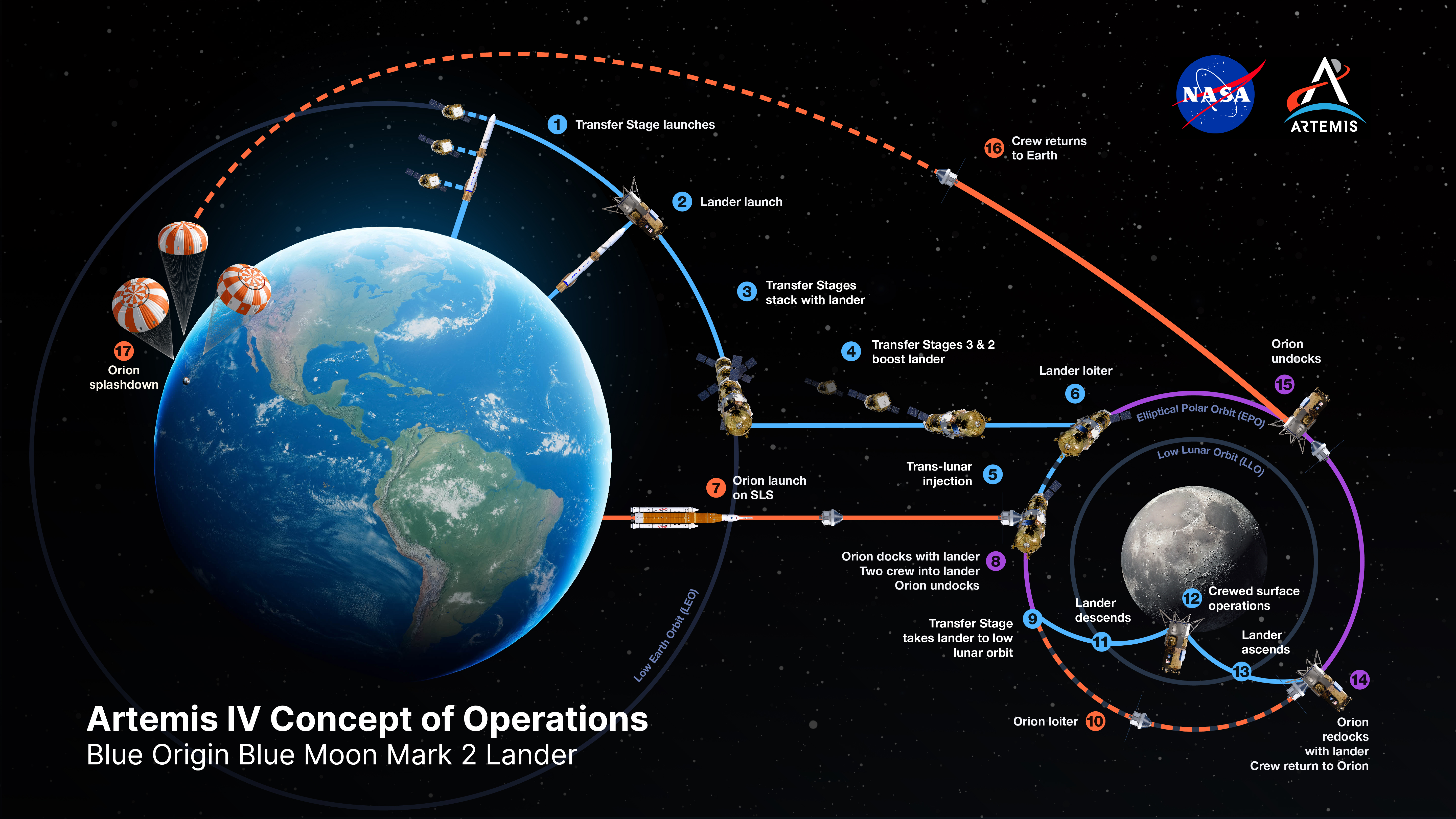
在其加速推进的 2028 年载人登月任务中,Blue Origin 将推迟推进剂转移,改用三级转移级将 Blue Moon Mark 2 Alpha 着陆器送往月球。这些转移级基于现有的 Mark 1 和 Mark 2 硬件,运行方式类似多级火箭。它们先进入近地轨道,随后 Mark 2 着陆器跟进。一旦对接完成,组合体便启程前往绕月椭圆极地轨道,各转移级在推进剂耗尽时逐级分离。与先前计划的近直线晕轨道相比,椭圆极地轨道能让宇航员更快从月球表面返回 Orion,减少 Blue Moon 着陆器的推进剂需求,并最大化 SLS 所能提供的性能。
这一架构为 SLS 和 Orion 提供了多次机会,将机组发射至椭圆极地轨道并与 Blue Moon Mark 2 着陆器对接。随后两名机组成员转入着陆器,下降抵达月球南极。完成月面作业后,着陆器返回 Orion,机组转入其中,踏上返回地球的旅程。
Blue Origin 将吸取此前支持该机构月球基地计划的 Mark 1 机器人任务的经验,并在一次无人着陆器转移级演示任务中演示完整的任务流程。
让美国宇航员重返月球
最终,NASA 将根据着陆器的准备情况,决定哪家公司率先被选中,在 2028 年安全地将宇航员送达月球表面并返回月球轨道。随后还将有第二次载人着陆机会。
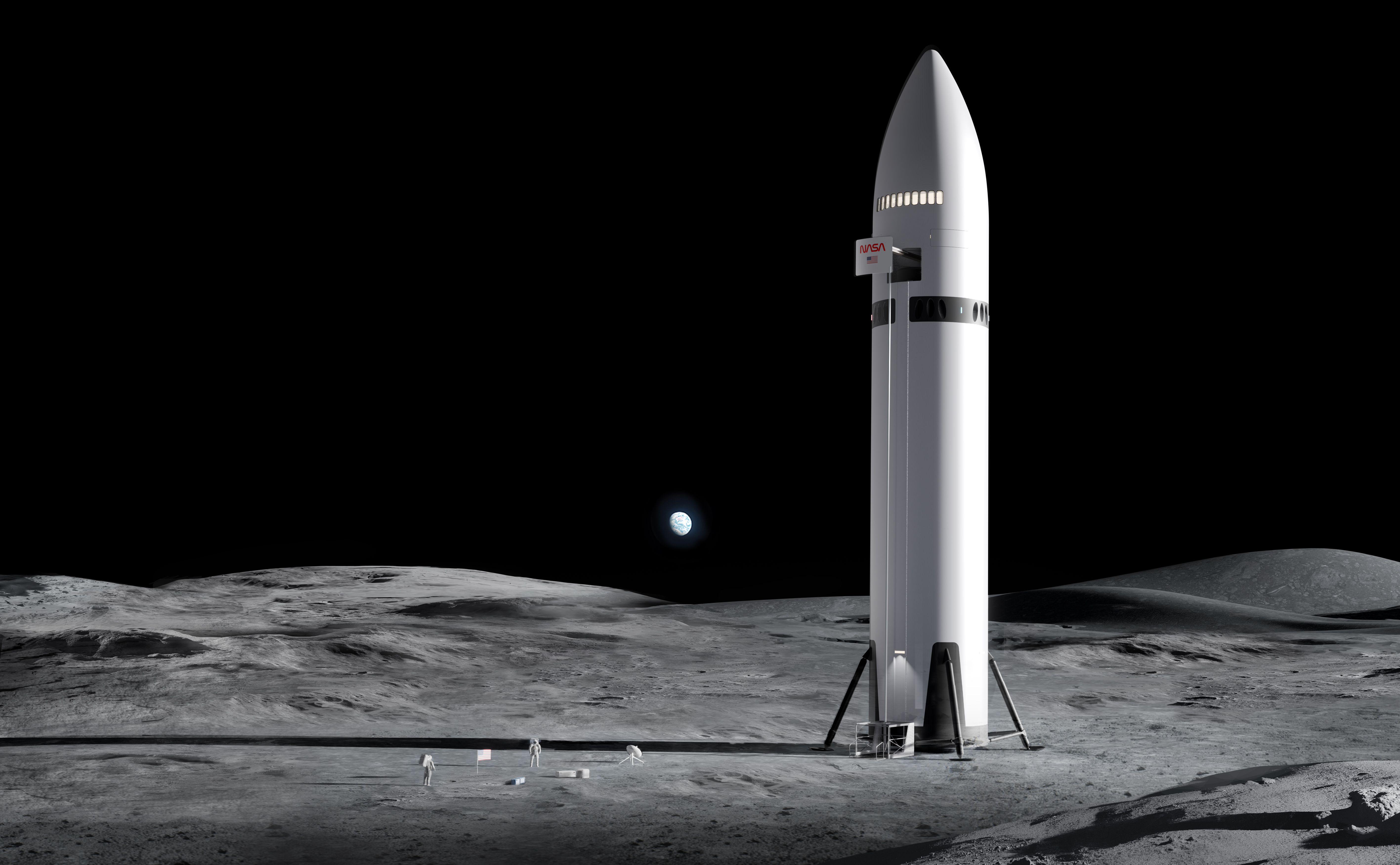
NASA 的目标是在初期的月面任务中,进行两次各约两小时长的月面行走。宇航员将利用月面行走采集月球样本,并测试由 Axiom Space 提供的宇航服性能。
今年早些时候,NASA 更新了与 Blue Origin 和 SpaceX 签订的、关于载人着陆系统及大型货运送月任务的合同。这些更新使该机构的载人着陆系统要求与今年早些时候宣布的加速努力保持一致,以精简 Artemis 任务架构、加快重返月球步伐,并支持更高的赴月任务节奏。
根据最初的 HLS 合同,SpaceX 的 Starship 载人着陆系统被分配给 Artemis III 和 IV 任务,而 Blue Origin 将使用其 Blue Moon Mark 2 载人着陆系统执行 Artemis V 任务。根据合同重排,两家供应商都将参与近地轨道上的 Artemis III 任务,且两家着陆器供应商均未被指派到特定的 Artemis 载人登月任务。
“NASA 与我们的月球着陆器供应商 Blue Origin 和 SpaceX 一直携手合作,确保我们能在 2028 年前让美国宇航员重返月球,”NASA Artemis 计划经理 Jeremy Parsons 表示。“尽管自 3 月 Ignition Day 宣布架构更新以来,我们一直在推进与合作伙伴的重排工作以予以支持,但更新合同能确保 NASA 及其合作伙伴在要求和其他里程碑上达成共识,从而持续掌握着陆器研发进展,保障任务成功及我们月球机组的安全。”
Blue Origin 和 SpaceX 都新增了研发里程碑,以便让 NASA 更深入地了解着陆器研发进展,在载人登月做准备的同时降低风险、提升宇航员安全。SpaceX 正为其 Starship 着陆器新增两次名为 Cabin 1 的乘员舱演示。Blue Origin 则新增了新的人机回路测试和硬件就绪里程碑,以精简训练开发以及地面和飞行操作。
作为创新与探索黄金时代的一部分,NASA 将派遣 Artemis 宇航员执行月球南极附近难度不断加大的任务,探索前所未有的更多月球区域。除了通过其月球任务带来经济效益、推动科学发现外,NASA 还将在月球表面建立持久的人类存在,并夯实该机构首次载人火星任务的基础。
展开英文原文 · 与中文逐段对应
NASA, Partners Accelerate Lander Development for 2028 Moon Missions - NASA
As NASA returns humans to the lunar surface and establishes a long-term presence on our closest celestial neighbor, the agency and commercial human landing system providers Blue Origin and SpaceX have streamlined the designs and changed both concepts of operations for its future crewed landers.
Since NASA established initial contracts with Blue Origin and SpaceX for crewed missions to the Moon, the agency has redefined Artemis III to demonstrate rendezvous and docking capabilities between test versions of landers from each provider and the agency’s Orion spacecraft in low Earth orbit next year. In parallel, the companies are also developing crew and cargo versions of their landers for near-term Artemis missions.
“We are executing President Trump’s National Space Policy to complete the long-awaited return of American astronauts to the lunar surface in 2028 and establish a Moon Base,” said NASA Administrator Jared Isaacman. “We have a proven foundation in SLS and Orion, along with two lunar landers in development with Blue Origin and SpaceX. But NASA has no intention of sitting idly by as all the pieces come together. That is not how Apollo succeeded, and it is not how the near-impossible is achieved. NASA is energized, our core capabilities are being rebuilt, our machine shops are running 24/7, and our experts are in the field attacking the critical path. We are building a Super Bowl-caliber team to safely achieve these objectives and everything that comes next.”
NASA is energized, our core capabilities are being rebuilt, our machine shops are running 24/7, and our experts are in the field attacking the critical path. We are building a Super Bowl-caliber team to safely achieve these objectives and everything that comes next.
Jared Isaacman
NASA Administrator
For the initial crewed missions to the Moon, Artemis astronauts will launch in the agency’s Orion spacecraft on top of the SLS (Space Launch System) rocket from NASA’s Kennedy Space Center in Florida. During each Artemis mission, a commercial human landings system will link up with Orion before taking two crew members to the lunar surface while two remain aboard Orion. To accelerate development toward a 2028 landing, the Artemis landers and Orion will no longer rendezvous in a near-rectilinear halo orbit around the Moon and instead meet up in an orbit that differs for each partner, informed by their systems.
Both companies are required to perform an uncrewed demonstration mission with their crewed landers prior to the near-term Artemis crewed missions to the Moon. NASA will certify lander systems prior to the crewed missions to ensure safety and mission success.
Starship lander concept of operations
SpaceX continues to plan for an in-space propellant aggregation approach to transfer super cold, or cryogenic, liquid propellant in space. The company will launch multiple versions of Starship to low Earth orbit prior to the launch of the Starship Human Landing System (HLS) from Florida. Similar to a gas station on Earth, the series of propellant “tanker” Starships in low Earth orbit will transfer propellant to the waiting “depot” Starship. The depot Starship will ultimately fuel the Starship lander for its journey to the Moon.
Under the revised operations, Starship HLS will await Orion and its crew in Earth orbit. The lander and Orion will rendezvous and dock in Earth orbit, then the Starship lander will perform a trans-lunar injection burn to send the combined lander and Orion stack to low lunar orbit. NASA is working to modify Orion to enable Starship to push it to the Moon. The lander will bring two crew members to the lunar surface for several days before delivering them back to Orion for the ride back to Earth.
Propellant aggregation in low Earth orbit allows for flexibility in the crew launch timing on SLS, while a trans-lunar injection burn performed by the Starship lander will enable direct access to low lunar orbit. This new concept of operations using low lunar orbit will significantly lower the amount of propellant Starship needs to aggregate in space while reducing the amount of time it can take for astronauts leaving the Moon’s surface in Starship to link back up with Orion. SpaceX will demonstrate the propellant aggregation approach during the uncrewed demonstration mission.
Blue Moon lander concept of operations
For its accelerated 2028 crewed lunar landing mission, Blue Origin will defer propellant transfer and use three transfer stages to send the Blue Moon Mark 2 Alpha Lander to the Moon. Based on existing Mark 1 and Mark 2 hardware, the stages operate like a multistage rocket. They launch into low Earth orbit, followed by the Mark 2 lander. Once docked, the stack departs for an elliptical polar orbit around the Moon, with each transfer stage separating as its propellant depletes. Compared with the previously planned near-rectilinear halo orbit, the elliptical polar orbit offers faster returns from the lunar surface to Orion, reduces Blue Moon lander propellant requirements, and maximizes the performance available by SLS.
This architecture provides multiple opportunities for SLS and Orion to launch the crew to elliptical polar orbit and dock with the Blue Moon Mark 2 lander. Two crew members then transfer to the lander and descend to the Moon’s South Pole. After surface operations, the lander returns to Orion, where the crew transfers for their journey back to Earth.
Blue Origin will incorporate lessons from earlier robotic Mark 1 missions supporting the agency’s Moon Base Program and demonstrate the full mission profile in an uncrewed lander transfer stage demonstration mission.
Returning American astronauts to the Moon
Ultimately, based on lander readiness, NASA will determine which company will be first selected to safely deliver astronauts to the Moon’s surface and back to lunar orbit in 2028. A second crewed landing opportunity will follow.
NASA is targeting two, approximately two-hour long lunar surface Moonwalks during initial surface missions. Astronauts will use the Moonwalks to collection lunar samples and test capabilities of the spacesuit provided by Axiom Space.
Earlier this year, NASA updated its contracts with Blue Origin and SpaceX for human landing systems and large cargo deliveries to the Moon. The updates align the agency’s human landing system requirements with acceleration efforts announced earlier this year to streamline Artemis mission architecture, expedite a lunar return, and support an increased mission cadence to the Moon.
Under the original HLS contracts, SpaceX’s Starship human landing system was assigned to the Artemis III and IV missions, while Blue Origin would use its Blue Moon Mark 2 human landing system for Artemis V. Under the contract realignments, both providers are participating in the Artemis III mission in low Earth orbit and neither lander provider has been assigned to a specific Artemis lunar landing mission.
“NASA and our lunar lander providers Blue Origin and SpaceX have been working hand in hand to ensure we can return American astronauts to the Moon by 2028,” said Jeremy Parsons, NASA’s Artemis program manager.“While work to realign with our partners in support of architecture updates announced at Ignition Day in March has been underway since then, updating the contracts ensures NASA and its partners are on the same page with requirements and other milestones to ensure continued insight into lander development to support mission success and the safety of our Moon crews.”
Both Blue Origin and SpaceX have added development milestones to provide NASA with more insight into lander development efforts, reducing risk and enhancing astronaut safety in preparation for crewed Moon landings. SpaceX is adding two demonstrations of its crew cabin, called Cabin 1, for its Starship lander. Blue Origin is adding new human-in-the-loop testing and hardware readiness milestones to streamline training development as well as ground and flight operations.
As part of a Golden Age of innovation and exploration, NASA will send Artemis astronauts on increasingly difficult missions near the lunar South Pole to explore more of the Moon than ever before. In addition to providing economic benefits and advancing scientific discovery though its Moon missions, NASA will establish an enduring human presence on the lunar surface and build on the agency’s foundation for the first crewed mission to Mars.
查看本期独立摘要
中文独立摘要 · AI 整理
这件事
NASA 宣布联合商业伙伴加速研制用于2028年阿尔忒弥斯(Artemis)载人登月任务的月球着陆器。作为让人类重返月球表面并建立长期驻留的一部分,NASA 正推进着陆器开发,相关测试飞行与系统验证也在同步进行,为后续常态化月球作业铺路。
本页概括所列来源的重点,属于独立摘要;完整报道请阅读原站。整理时间:2026年10月24日 07:49(北京时间)。
信息从哪里来
据NASA新闻发布报道(英文原文),由本站译为全文中文。
- NASA 新闻发布 报道正文